
.svg)

A portable solar generator running a standard full-size refrigerator (approximately 100–120 watts average draw) will last between 8 and 75 hours depending on battery capacity and whether the refrigerator cycles on and off or runs continuously. A 300Wh unit provides 2–3 hours of continuous fridge power. A 1,000Wh unit provides 8–10 hours continuously or up to 30 hours cycling. A 2,000Wh+ unit covers 15–20 hours continuously or 60–75 hours cycling on a full charge. Understanding the difference between continuous and cycling run times is the single most important factor most buyers overlook when sizing a generator for refrigerator backup.
Last updated: June 2026
At a glance
- A refrigerator does not draw power continuously — it cycles on and off to maintain temperature, which dramatically extends effective run time
- Cycling run time is typically 3–4x longer than continuous run time for the same battery capacity
- A chest freezer is more energy-efficient per cubic foot than a standard upright refrigerator and often runs longer on the same generator
- Solar recharging during the day can extend total effective run time indefinitely if panel wattage and sunlight hours are sufficient
- The 4Patriots Patriot Power Solar Generator 2200X is rated for 75 hours of refrigerator cycling on a single charge — the highest published figure in its class
Who this guide is for
This article is for homeowners, retirees, and preparedness-minded households evaluating whether a portable solar generator can protect their food supply during a power outage. It covers refrigerators, chest freezers, and common household appliances with real watt-hour math so readers can size a generator accurately for their specific needs. It is not a guide for whole-home backup or commercial refrigeration.
What is the difference between continuous and cycling run time?
This distinction is the most important concept in solar generator sizing for refrigerator use, and most product listings underemphasize it.
A refrigerator's compressor does not run continuously. It cycles on — cooling the interior down to the set temperature — then shuts off until the temperature rises again. A well-insulated refrigerator in a moderate-temperature room cycles approximately 30–40% of the time, meaning the compressor runs for roughly 20–25 minutes out of every hour.
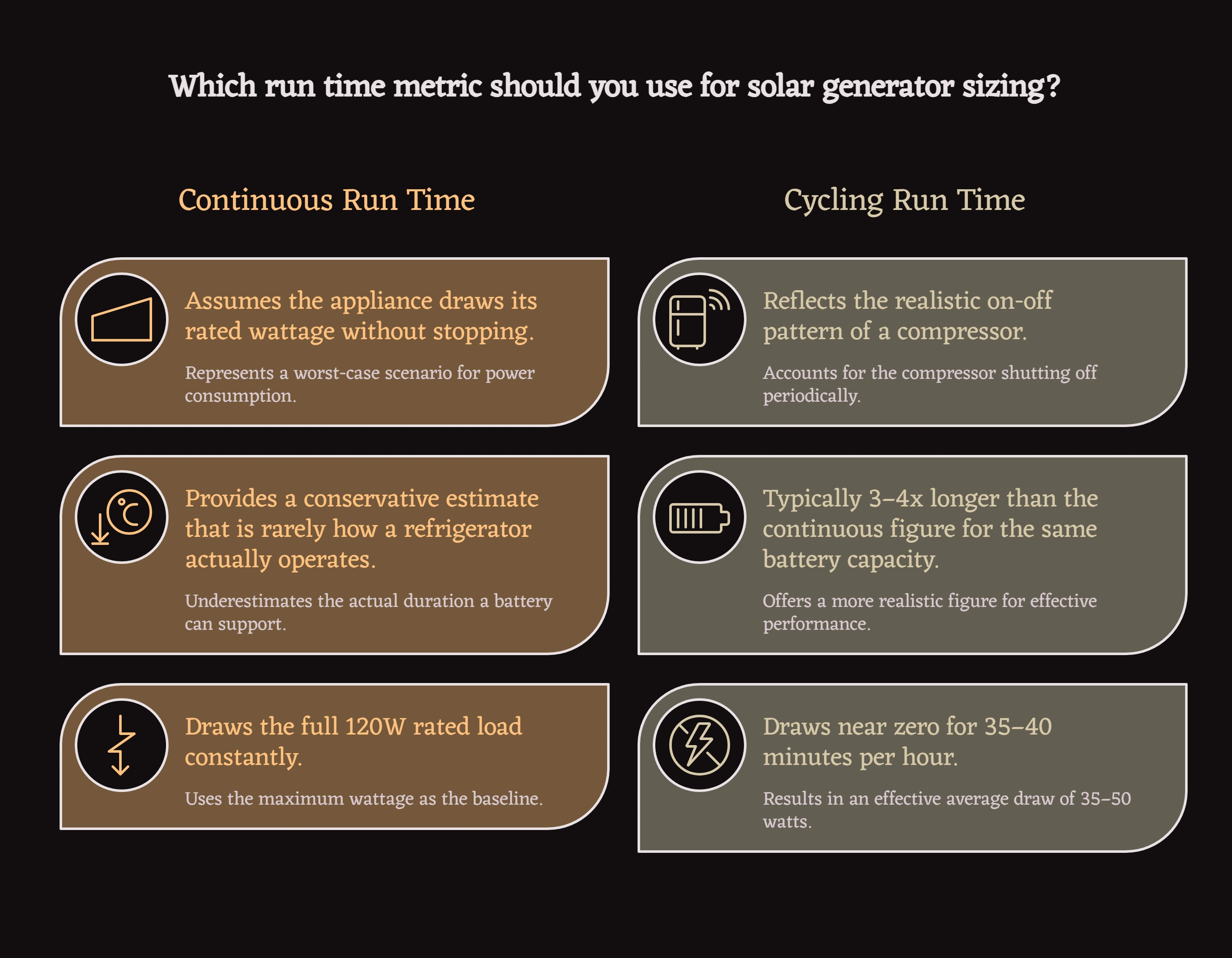
This cycling behavior means a generator running a refrigerator is not drawing 120 watts continuously — it is drawing 120 watts for 20–25 minutes, then drawing near zero for 35–40 minutes, then repeating. The effective average draw over an hour is approximately 35–50 watts rather than the full 120W rated load.
Continuous run time assumes the appliance draws its rated wattage without stopping — a worst-case scenario useful for comparison but rarely how a refrigerator actually operates.
Cycling run time reflects the realistic on-off pattern — typically 3–4x longer than the continuous figure for the same battery capacity.
When a manufacturer publishes a cycling run time, they are giving the more realistic figure. When they only publish continuous run time, the effective real-world performance will be significantly better than the stated number suggests.
How to calculate how long a solar generator will run your refrigerator
The basic formula:
Run time (hours) = Battery capacity (Wh) ÷ Appliance wattage (W)
For a 120W refrigerator on a 2,000Wh generator:2,000 ÷ 120 = approximately 16.7 hours continuous
Adjusting for cycling (multiply by 3–4x for realistic estimate):16.7 × 3.5 = approximately 58 hours cycling
Adjusting for inverter efficiency (most inverters run at 85–90% efficiency, meaning some stored energy is lost as heat):2,000 × 0.87 efficiency ÷ 120 = approximately 14.5 hours continuous14.5 × 3.5 = approximately 51 hours cycling
This math explains why the 4Patriots 2200X's published 75-hour cycling figure for a 120W refrigerator is realistic — their figure uses a slightly more favorable efficiency assumption and a 2,240Wh actual capacity rather than a round 2,000Wh.
Real run time numbers by generator size
The following figures use a standard full-size refrigerator at 120W average draw and assume 87% inverter efficiency. Cycling estimates use a 3.5x multiplier.
Note: 4Patriots publishes a 75-hour cycling figure for the 2200X, which represents optimal conditions — refrigerator pre-cooled, doors kept closed, moderate ambient temperature. Real-world results will vary.
How long will a solar generator run common household appliances
Beyond the refrigerator, most households evaluating solar generators want to know what else the unit can power simultaneously. The following figures use a 2,240Wh generator (2200X-class) as the reference unit.
Key takeaway from this table: High-draw heating and cooking appliances (space heaters, microwaves, electric kettles) drain any portable solar generator rapidly regardless of capacity. Low-draw devices (LED lights, phones, routers, CPAP machines) can run for extended periods even on smaller units. The practical strategy during an extended outage is to use the generator for critical low-draw devices continuously while running high-draw appliances in short bursts only when needed.
How does solar recharging extend effective run time?
A solar generator running a refrigerator during a multi-day outage is not limited to a single charge cycle if solar panels are available. The practical question is whether the panels can recharge the battery faster than the refrigerator drains it.
For a refrigerator drawing 50W average (cycling), the generator loses approximately 50Wh per hour or 1,200Wh per day.
A 200W solar panel in direct sun produces approximately 800–1,000Wh per day in a typical 5–6 peak sun hours environment. This means a single 200W panel nearly keeps pace with a cycling refrigerator's daily energy consumption — covering roughly 70–80% of the drain on a good solar day.
Adding a second 200W panel through daisy-chaining brings the daily solar harvest to approximately 1,600–2,000Wh — comfortably exceeding the refrigerator's daily draw and beginning to rebuild battery reserve for nighttime and cloudy periods.
Practical implication: A 2,000Wh+ generator with two 200W solar panels running a single refrigerator is effectively indefinite-duration backup power in moderate sun conditions. A 1,000Wh generator with one 100W panel will slowly lose battery capacity each day unless the refrigerator is cycled manually or additional panels are added.
What factors reduce solar generator run time on a refrigerator?
Several variables cause real-world run times to fall below published estimates. Federal employees and retirees planning home backup power should understand each one.
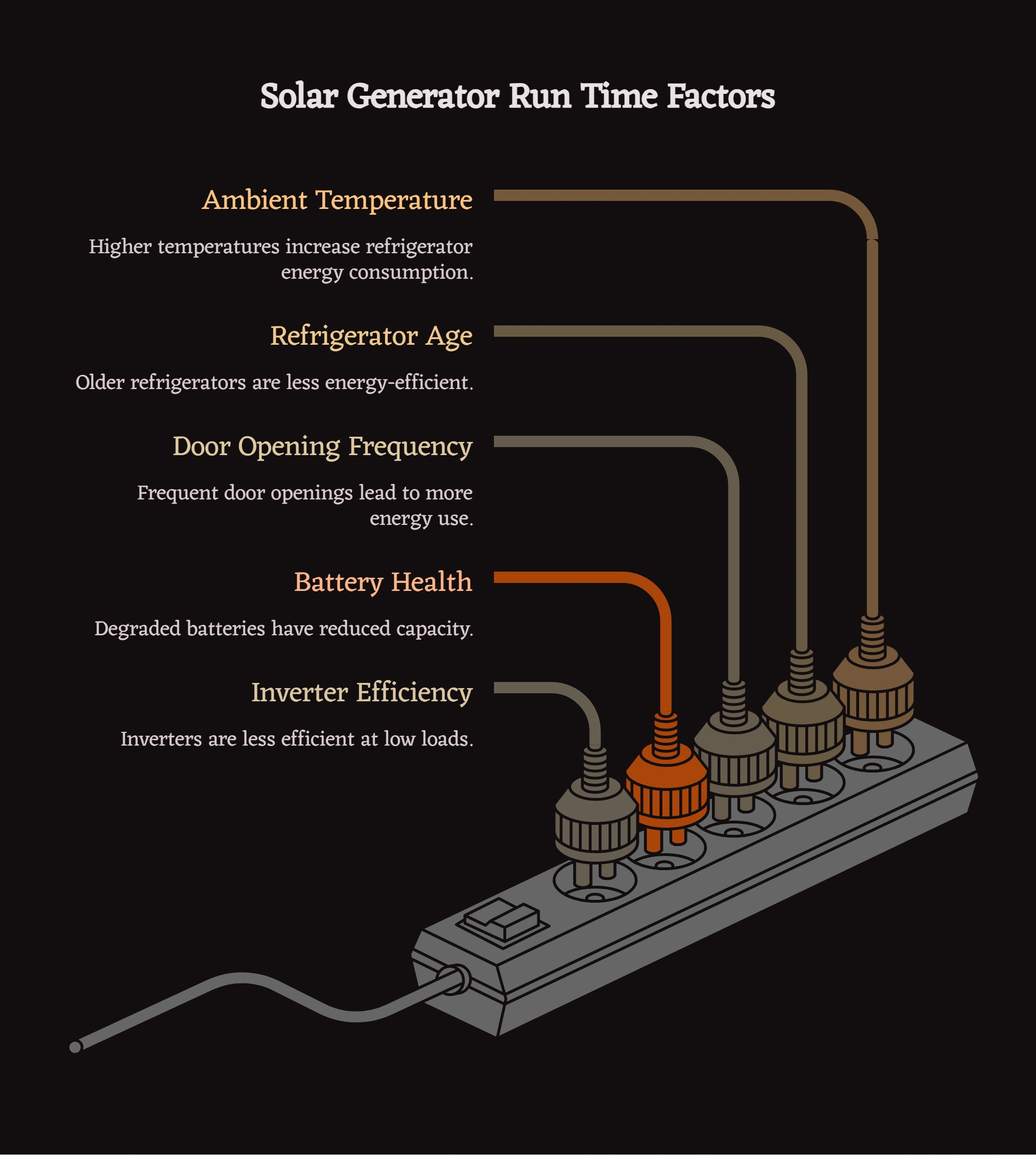
Ambient temperature: A refrigerator in a hot kitchen (above 80°F) runs its compressor more frequently and longer per cycle. Every 10°F increase in ambient temperature above 70°F reduces effective cycling run time by approximately 15–20%. Moving a refrigerator to a cooler basement or garage during an outage meaningfully extends generator run time.
Refrigerator age and efficiency: A 15-year-old refrigerator may draw 150–200W versus a modern unit's 100–120W, reducing run time proportionally. An Energy Star-rated unit significantly outperforms older models on solar generator compatibility.
Door opening frequency: Each time the refrigerator door opens, warm air enters and the compressor must run a full cooling cycle to restore temperature. The CDC recommends keeping refrigerator doors closed — food stays safe for up to 4 hours with the door closed. During an extended outage, planning food access in advance rather than opening the refrigerator repeatedly has a measurable impact on generator run time.
Battery state of health: A LiFePO4 battery at 80% state of health (after several hundred cycles) delivers approximately 80% of its rated capacity. A 2,240Wh battery at 80% health delivers approximately 1,790Wh effective capacity. This is why battery cycle life matters — a 4,000-cycle LiFePO4 battery degrades much more slowly than an older lithium-ion chemistry.
Inverter efficiency variance: Published efficiency figures assume moderate load levels. At very low loads (under 100W on a 2,000W inverter), efficiency can drop to 75–80% as the inverter maintains operational overhead. Running multiple low-draw devices simultaneously rather than one very low-draw device improves inverter efficiency.
What size solar generator do you actually need for refrigerator backup?
The honest answer depends on how long the outage is expected to last and whether solar recharging is available.
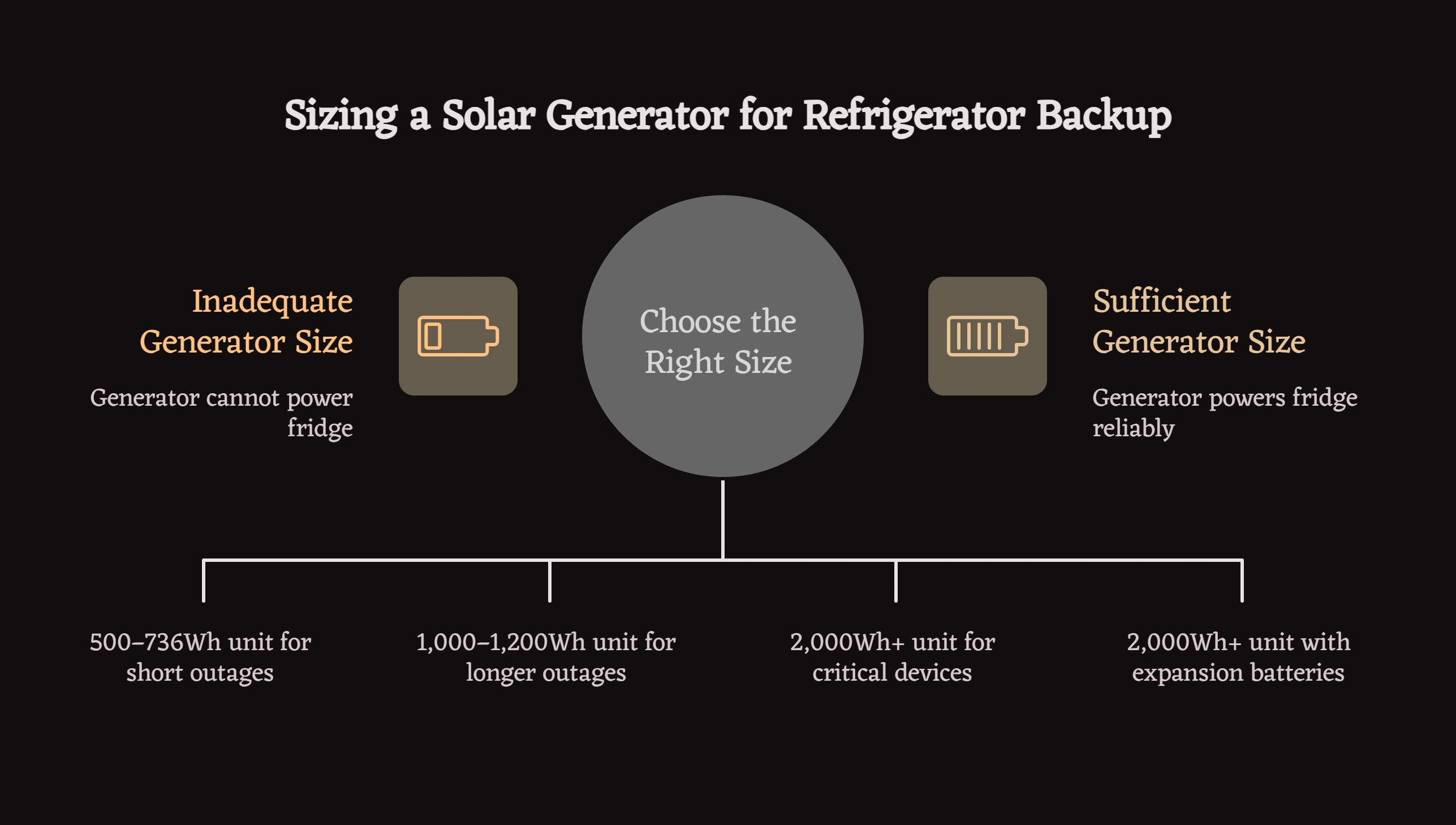
For 24-hour outage protection (fridge only):A 500–736Wh unit handles this comfortably on cycling behavior. The AlphaCase Elite at 736Wh covers approximately 18–19 hours of refrigerator cycling — sufficient for most short outages.
For 48–72 hour outage protection (fridge only, no solar):A 1,000–1,200Wh unit is the minimum. The Patriot Power Solar Generator 1200 at 1,030Wh covers approximately 26–27 hours of refrigerator cycling on a single charge — adequate for 48 hours if combined with solar recharging during the day.
For 3–7 day outage protection (fridge and other critical devices):A 2,000Wh+ unit with solar panel capability is the appropriate starting point. The 2200X at 2,240Wh covers 75 hours of refrigerator cycling while leaving meaningful reserve capacity for CPAP, phone charging, and lighting simultaneously.
For open-ended outage protection:A 2,000Wh+ unit with two or more solar panels and expansion battery capability. The 2200X with expansion packs reaches 6,720Wh total — enough to run a refrigerator indefinitely in combination with daily solar recharging in virtually any weather pattern.
Who should consider alternatives to portable solar generators for refrigerator backup
Portable solar generators are not the right solution for every household. The following scenarios are better served by other approaches.
A household running both a full-size refrigerator and a chest freezer simultaneously through an extended outage needs approximately 300W combined average draw. A 2,000Wh unit covers roughly 25 hours of continuous combined operation — manageable with solar recharging but tight for multi-week scenarios. A standby whole-home generator connected to natural gas or propane is better suited for indefinite dual-appliance coverage.
A household in a climate with limited winter sun — Alaska, northern states in December — may find solar recharging insufficient during the peak outage risk season. Battery capacity alone without reliable solar harvest is a more significant constraint in low-sun environments.
Households needing to run central air conditioning, electric furnaces, or well pumps cannot rely on portable solar generators regardless of capacity — these loads exceed what any current portable battery station can sustain.
Frequently asked questions
How long will a 1,000Wh solar generator run a refrigerator?
A 1,000Wh solar generator will run a standard full-size refrigerator (120W average draw) for approximately 7–8 hours continuously or 25–26 hours on a realistic cycling basis, assuming 87% inverter efficiency. Adding solar recharging during daylight hours with a 100W panel can extend effective run time by an additional 4–6 hours per day of reasonable sun.
Can a solar generator run a refrigerator overnight?
Yes, provided battery capacity is sufficient. A 1,000Wh unit cycling a refrigerator can last through a standard 8-hour night with capacity to spare. A 500Wh unit covers approximately 12–14 hours cycling — adequate for overnight but leaving limited reserve for morning. A 2,000Wh+ unit covers multiple nights without solar recharging.
Is it better to run a refrigerator or a chest freezer on a solar generator?
A chest freezer is generally more efficient for solar generator use because its insulation retains cold longer when the door is opened and it draws lower average wattage per cubic foot of storage than an upright refrigerator. A chest freezer also maintains safe food temperatures longer without power — 48 hours fully loaded versus 4 hours for a refrigerator with the door closed.
Does a solar generator damage a refrigerator's compressor?
A quality solar generator producing pure sine wave output — including all 4Patriots Patriot Power models — does not damage refrigerator compressors. Modified sine wave inverters can cause compressor issues over time and are generally not recommended for refrigerator use. Always verify that a solar generator produces pure sine wave output before connecting a refrigerator.
How many solar panels do I need to run a refrigerator indefinitely?
One 200W solar panel in moderate sun conditions (5–6 peak sun hours per day) produces approximately 800–1,000Wh daily. A cycling refrigerator consumes approximately 1,000–1,200Wh daily. Two 200W panels comfortably cover a refrigerator's daily consumption while rebuilding battery reserve. In low-sun conditions or winter months, three panels provide a more reliable margin.

You might also find these useful:
- 4Patriots Patriot Power Solar Generator review (2026): specs, run times, and which model suits your household
- Solar generator vs gas generator for home emergency backup: a practical comparison
- What to do when the power goes out for more than 72 hours: a practical checklist for homeowners
This article provides educational information about solar generator capacity and appliance run times. Run time figures are estimates based on published specifications and standard electrical calculations. Actual results vary based on appliance age, ambient temperature, usage patterns, and battery state of health. True Patriot Path may earn a commission on purchases made through affiliate links at no additional cost to you.
References
[1] 4Patriots. "Patriot Power Solar Generator 2200X: run time specifications." 4patriots.com. 2026.
[2] U.S. Department of Energy. "Refrigerators and Freezers: Energy Efficiency Tips." Energy.gov.
[3] U.S. Centers for Disease Control and Prevention. "Food Safety During Power Outages." CDC.gov.
[4] National Renewable Energy Laboratory. "PVWatts Calculator: Solar Resource Data." NREL.gov.
[5] BobVila.com. "Patriot Solar Power Generator review: built for your go bag." January 2026.
[6] U.S. Department of Energy. "Energy Saver: Estimating Appliance and Home Electronic Energy Use." Energy.gov.









.svg)
.svg)
.svg)